By: Sid Peddinti
Tax & IP Lawyer, Growth Strategist, and Legal Publisher.

Dear Friends,
I’ve had the opportunity to work with hundreds of business owners who have built healthy 7- and 8-figure companies just off social media, in all sorts of industries, and have also had to deal with our fair share of hurdles and derailments. In this article, I will share some of the questions posed to us by various clients over the years, questions that led us to investigate the terms and conditions in greater detail, and examples of how a business owner can protect and preserve their ideas, insights, and IP from being copied, duplicated, and stolen online.
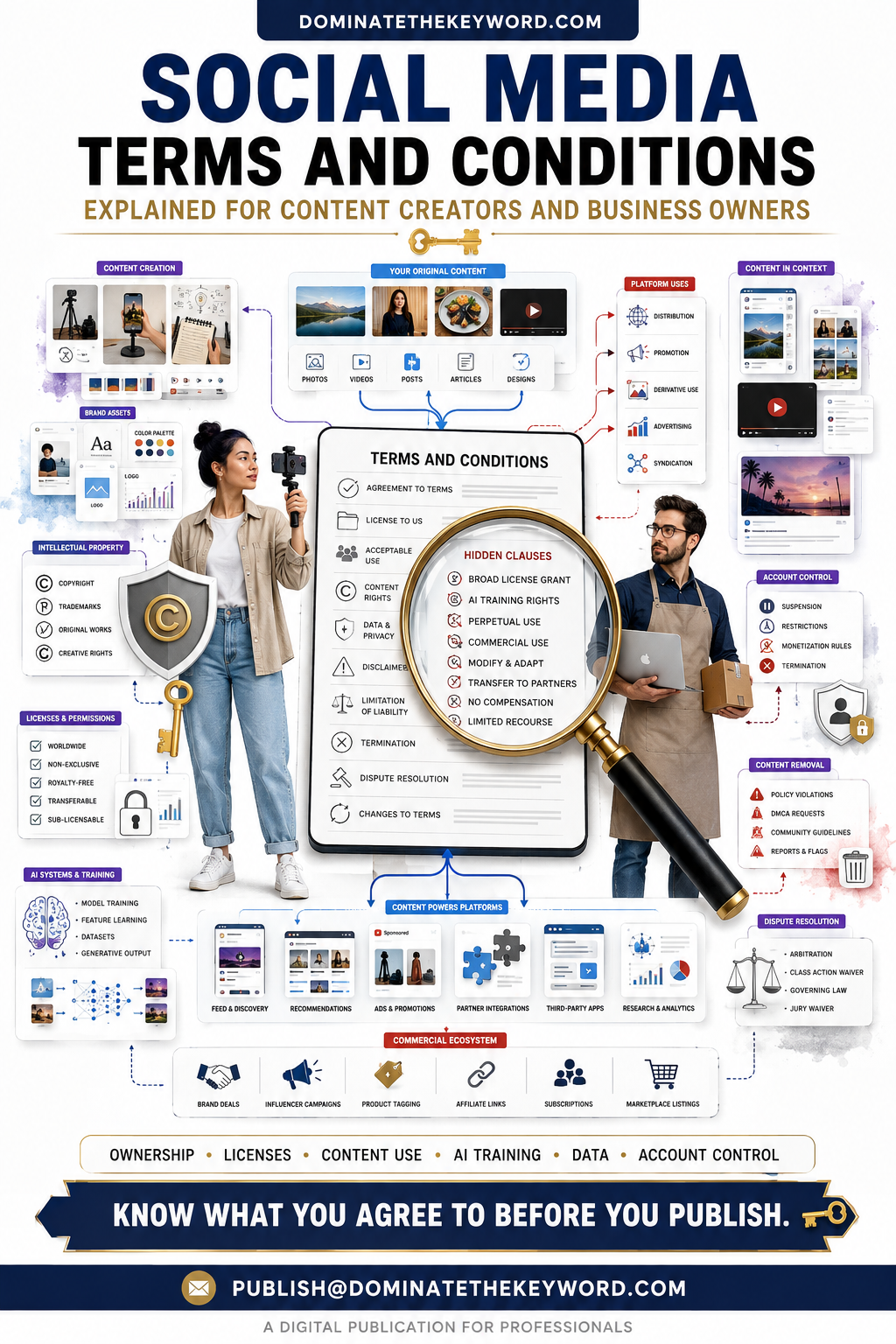
While social media platforms offer vast reach and exposure, they operate under terms and conditions that often grant them extensive rights to user-generated content, potentially diminishing creators’ long-term control and monetization opportunities.
Establishing and nurturing independent online platforms, such as personal websites, blogs, or digital publications, is crucial for securing intellectual property (IP) rights, maintaining direct audience engagement, and ensuring business continuity. In this article, we will examine the questions
Key Takeaways
- Social media platforms are “rented” spaces where users typically don’t own their accounts or the perpetual rights to their content.
- Terms and conditions on most social media sites grant platforms broad, perpetual, royalty-free licenses to use, modify, and distribute user content.
- Building independent online platforms (e.g., a website, blog, or digital magazine on a self-hosted CMS like WordPress) is essential for retaining full IP rights and control.
- Migrating audience engagement and primary content links to owned platforms helps secure your digital assets and reduces dependency on third-party policies.
- Ownership of your platform provides stability, direct data insights, and insulation from sudden policy changes or account terminations by social media companies.
Table of Contents
- Understanding Social Media Platform Ownership
- What Are the Implications of Social Media Terms and Conditions for Content Creators?
- Why Is It Critical to Build Your Own Independent Online Platforms?
- How Do Independent Platforms Help You Control Your Intellectual Property?
- What Are the Risks of Relying Solely on Social Media for Content Distribution?
- How Can I Transition My Audience and Content From Social Media to My Own Platform?
- What Types of Independent Platforms Can I Build?
- Is WordPress Still a Recommended Platform for Building Independent Websites in 2026?
Understanding Social Media Platform Ownership
Do I truly “own” my social media accounts and the content I post on them?
No, when you create a social media account, you do not actually “own” the account itself or, in many cases, the full rights to the content you publish on it. Social media platforms typically grant users a license to use their services, meaning you are essentially “renting” your presence on their platform. These accounts can be suspended or terminated by the platform at any moment, often without extensive recourse, based on their ever-evolving terms and conditions. The content you post, while you may retain copyright, is usually subject to broad usage licenses granted to the platform.
What Are the Implications of Social Media Terms and Conditions for Content Creators?
How do social media terms and conditions impact my intellectual property rights?
The terms and conditions (T&Cs) of most major social media platforms significantly impact your intellectual property (IP) rights. While you generally retain the copyright to your original creations, these platforms typically require users to grant them a broad, non-exclusive, royalty-free, transferable, sub-licensable, worldwide license to use, reproduce, modify, adapt, publish, translate, create derivative works from, distribute, publicly perform, and publicly display your content. This means the platform can use your content for its business purposes, including marketing, improving services, and even creating new products, without owing you any compensation.
What does it mean to grant “perpetual royalties and rights to create derivative works” to a social media platform?
When you agree to the T&Cs, the “perpetual royalties and rights to create derivative works” clause means that the platform can use your content indefinitely, even if you delete your account, and does not need to pay you for this usage. Read that again.
Furthermore, they are granted the right to transform your original content into new forms (derivative works) for their own purposes. For example, a platform could use snippets of your video in an advertisement, remix your images, or incorporate your text into their AI training data without your further permission or payment. This effectively diminishes your exclusive control over how your original work is leveraged beyond your initial posting.
Imagine logging in and finding competitors’ ads displayed on your profile, in between your content, or even an ad that uses your content to sell someone else’s offers (a competitor’s technology that solves the problem you are discussing). If you are good at reading between the lines – you’ll begin to see this is more than an observation or research-oriented article – we’re sharing personal experiences in this one. I’ve experienced this – platforms using my original content and ideas to sell competitive products – and you know something – I don’t really blame them. If you owned a social media platform, you would do the same thing – maximize the digital real estate and the tenants who are on it (business owners and consumers).
Why Is It Critical to Build Your Own Independent Online Platforms?
Why is building an independent online platform, rather than relying solely on social media, so important?
Building your own independent online platform is critical because it provides you with complete ownership and control over your content, intellectual property, and audience data. Unlike social media, where your presence is rented and subject to third-party rules, an owned platform grants you autonomy. This ensures long-term stability for your brand or business, protects you from sudden platform policy changes, account suspensions, or algorithmic shifts that can severely impact your reach and revenue. It also allows you to cultivate a direct relationship with your audience without intermediaries.
How Do Independent Platforms Help You Control Your Intellectual Property?
How does owning my platform help me control my IP and original publications?
Owning your platform – such as a self-hosted website or blog – gives you undisputed control over your intellectual property (IP). When you publish content directly on your own platform, you retain all exclusive rights unless you explicitly choose to license them. This contrasts sharply with social media, where you grant broad usage licenses simply by posting.
On your own platform, you dictate the terms of use, control monetization, prevent unauthorized derivative works by third parties (other than the platform itself), and ensure that your original publications remain uniquely yours. This is vital for creators, businesses, and anyone serious about protecting their digital assets.
What Are the Risks of Relying Solely on Social Media for Content Distribution?
What are the primary risks associated with relying exclusively on social media for content dissemination?
Relying exclusively on social media for content dissemination exposes creators to several significant risks:
- Account Termination: Platforms can suspend or delete your account at any time, often with little to no warning or clear explanation, leading to a complete loss of your audience and content presence.
- Algorithmic Changes: Frequent changes to platform algorithms can drastically reduce your organic reach, making it harder for your audience to discover your content without paid promotion.
- Content Deletion/Censorship: Platforms have the right to remove content they deem to violate their guidelines, even if you believe it adheres to them, potentially erasing significant portions of your work.
- Loss of Direct Audience Connection: Social media acts as an intermediary, limiting your direct communication and data insights about your audience, which are crucial for strategic growth.
- Limited Monetization Options: Monetization features are dictated by the platform, which often takes a significant cut or restricts earning potential.
- IP Rights Dilution: As discussed, broad licenses granted to platforms can dilute your control over your creative works.
How Can I Transition My Audience and Content From Social Media to My Own Platform?
What strategies can I employ to move my audience and content links from social media to my owned platform?
To effectively transition your audience and content links, consider these strategies:
- Consistent Promotion: Regularly link to your independent platform in your social media posts, bios, stories, and profiles. Make it clear that your primary content and most valuable offerings reside on your owned site.
- Exclusive Content: Offer exclusive content, deeper dives, or early access to new materials only available on your independent platform, providing a compelling reason for your audience to visit.
- Lead Magnets: Use email sign-ups on your owned platform to build a direct communication channel. Offer a valuable download (e.g., an e-book, guide, template) in exchange for an email address.
- Call-to-Actions (CTAs): Integrate clear and frequent CTAs on your social media to “Learn More,” “Read the Full Article,” or “Visit My Website.”
- Repurpose Smartly: Use social media to share snippets or highlights of your content, always directing users to your main platform for the complete experience.
- Community Building: Foster a sense of community directly on your owned platform through comments, forums, or dedicated sections, encouraging deeper engagement away from social media.
What Types of Independent Platforms Can I Build?
What kinds of independent online platforms can I launch to secure my content and IP?
You can launch various types of independent online platforms, tailored to your specific needs:
- Personal Website/Blog: Ideal for individuals, thought leaders, and small businesses to publish articles, portfolios, and personal updates.
- Online Publication/Magazine: For creators focusing on longer-form content, niche topics, or collaborative editorial work, offering a more structured reading experience.
- E-commerce Store: If your primary goal is selling products or services, an independent e-commerce site provides full control over sales, inventory, and customer data.
- Membership Site/Community Forum: For building an exclusive community, offering premium content, courses, or interactive discussions behind a paywall.
- Online Course Platform: If you’re an educator or expert, a dedicated platform allows you to host and sell your courses directly.
These platforms should be built on independent, self-hosted content management systems (CMS) that you own and control, rather than relying on proprietary, closed systems.
Is WordPress Still a Recommended Platform for Building Independent Websites or Should We Use AI Platforms?
Is WordPress still a robust platform, or should we build AI websites on platforms like Replit, Manus, Base 44, or custom-host Claude websites?
We started using WordPress in 2006 – and by 2010, we were building complex applications and functions using WordPress. In 2013, we tested out Shopify, then moved to Wix, Squarespace, Leadpages, ClickFunnels, GohighLevel, then moved to various AI platforms, including the ones mentioned in the question – Base44, Claude, Manus, Replit, and a few other “AI” website-platforms.
In 2025, we decided to go back to WordPress and found out that the articles, videos, and content we were posting surfaced on Google and AI within the week. We have built websites with hundreds of pages using ClickFunnels, GohighLevel, and even Claude – but none of those surface, let alone get indexed, by Google or AI platforms.
Did you know that WordPress powers 43% of all websites on the internet?
Its enduring popularity stems from its open-source nature, allowing for complete customization and control over your site’s design, functionality, and data. It supports everything from simple blogs to complex e-commerce stores and online magazines. Its vast community, continuous development, and countless plugins and themes ensure it stays updated with modern web standards and security, making it a reliable and scalable choice for owning your online presence.
What Is Dominate The Keyword About?
Why is dominating the keyword important in this day and age?
Dominating the keyword™ is not just about the “keyword”, but it is in reference to dominating a topic, controlling the narrative in the market, and redirecting the flow of traffic to your website.
When someone has a problem or topic pop-up in their head, they go online and ask questions, look for suggestions, or hunt for information. They “keyword” or search phrase they type in will determine the output(s) – the results that populate.
We’re referring to showing up on Google first and second pages, on Google AI Overviews in several places, and also in AI searches – not just when someone types in your profession, such as dentist near me, or attorney near me, or dentist in Los Angeles. We’re referring to showing up whereever the search goes – you are listed, your magazine shows up, and you are one of the cited experts – no matter where they search.
This is about becoming the “source of knowledge and truth” that humans and AI bots can trust. That’s what Dominating The Keywrord is really about – become THE most obvious choice for someone looking for solutions in your niche.
That’s it for now – please take a peek at the sources listed below, which contain all the links to the various platforms and their “terms and conditions”. Don’t forget to read it thoroughly and your rights are stated on there.
References
- Meta Platforms, Inc. (2024) – Facebook Terms of Service
- X Corp. (2024) – X Terms of Service
- U.S. Copyright Office (2024) – Copyright Law of the United States
- TikTok Inc. (2024) – TikTok Terms of Service
- YouTube LLC (2024) – YouTube Terms of Service
- WordPress.org (2026) – WordPress Usage Statistics
Disclaimer: This content is for informational purposes only and not legal advice. For specific legal guidance, consult with a qualified attorney.
Authored by Sid Peddinti, Esq.

Leave a Reply